Beyond "Doing Chores": How Practical Life Activities Build Independent, Confident Children
In our daily lives as adults, we take maintenance tasks for granted. Washing dishes, wiping down counter space, folding laundry, and caring for plants are simply things that need to get done.
Young children, however, see these everyday actions completely differently. In early childhood, children yearn to participate in the real work of their adult world.
In a Montessori environment—both at home and in our Children’s House (ages 3–6) classrooms at Stepping Stones Montessori School—we refer to these meaningful everyday tasks as Practical Life activities. Far from being simple "chores" or busywork, Practical Life is a cornerstone of Montessori education that builds internal motivation, physical coordination, spatial reasoning, and executive function.
The Dual Purpose of Practical Life: External Task, Internal Transformation
Practical Life activities always have two distinct purposes: one external and visible, and one internal and profound.
- The External Aim: Completing a tangible, real-world task. For example, scrubbing a table results in a clean surface where classmates can eat or work.
- The Internal Aim: Building a child’s sense of capability, independence, and self-worth.
When a three- or four-year-old carries a small basin of water, lathers soap with a brush, scrubs a table in circular motions, and dries it with a towel, they are doing much more than cleaning. They are developing fine motor control, executing complex multi-step sequences, refining hand-eye coordination, and learning that they are capable, contributing members of their community.
The small opportunities for independence we offer children in early childhood directly lay the foundation for the self-reliance, responsibility, and planning skills they will need as adults.
Purposefully Prepared Environments
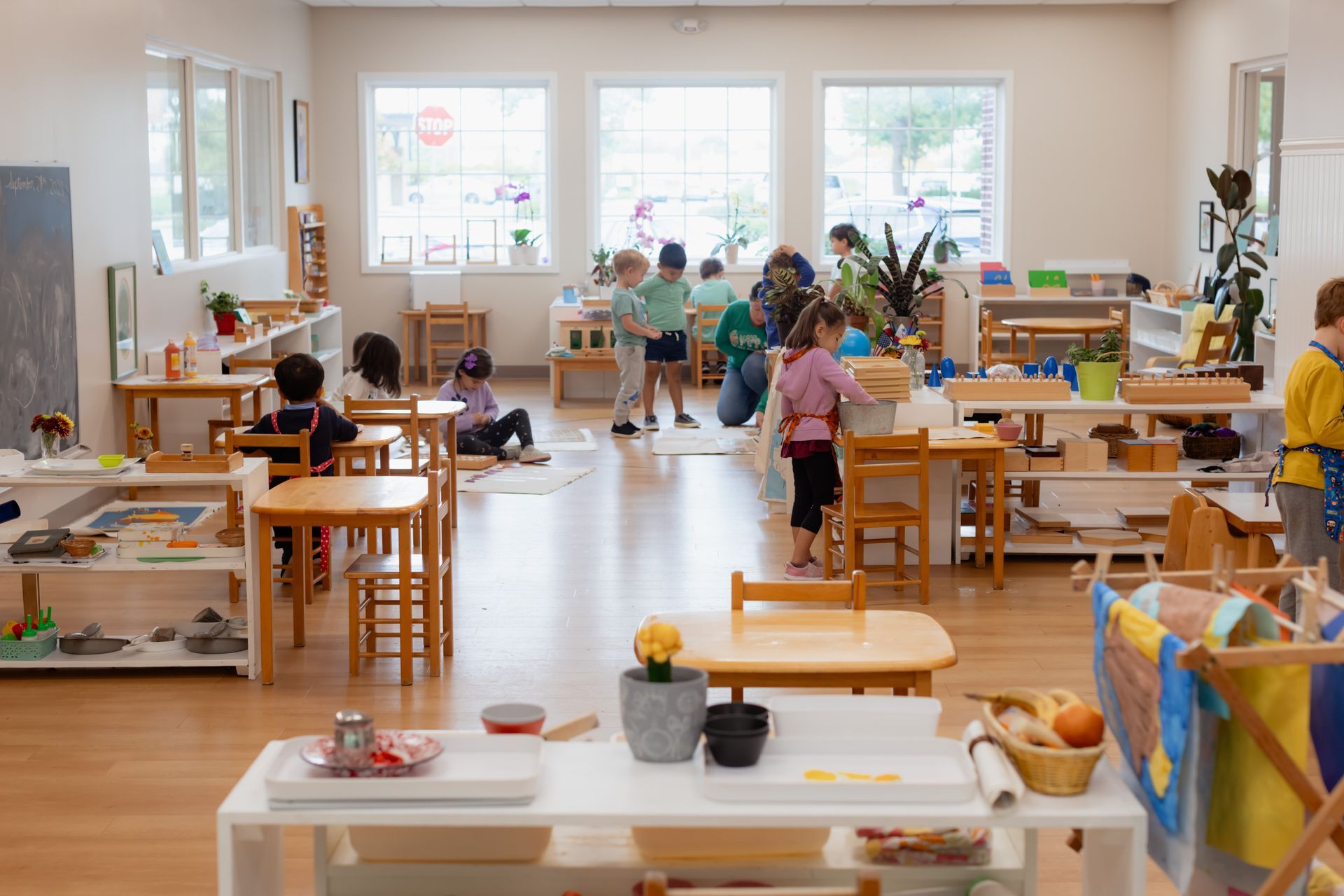
Why are young children able to achieve such high levels of independence in a Montessori classroom? It comes down to our prepared environment.
In our Children’s House classrooms at Stepping Stones Montessori, everything is deliberately scaled to the child:
- Sinks and counter heights are accessible without adult assistance.
- Faucets are easy for small hands to turn on and off independently.
- Soap containers dispense just the right amount for small hands.
- Child-sized mops, brooms, pitchers, and glass vases fit small hands perfectly.
When children are given real tools designed for their size, they can perform tasks independently that were previously done for them. This shift from passive recipient to active participant is where true confidence takes root.
Practicing Self-Care and Environmental Care
Practical Life work in our Children’s House falls into two primary categories:
1. Care of Self
Long before a child writes longform sentences or solves multi-digit equations, they learn to care for their own physical needs. Tasks like washing hands, buttoning coats, zipping jackets, tying shoes, and preparing a snack give children complete control over their personal care.
Even with toddlers, this begins with collaboration rather than adults taking over: "I am going to help you put on your shirt. Let's put your arm through this sleeve together." Over time, adult assistance steps back as the child's independence steps forward.
2. Care of the Environment
Children have a natural, biological desire to care for their surroundings when given the opportunity. If a houseplant's leaves are dry, a child waters it. If a glass spills, a child uses a sponge to mop up the water. If a table is dirty, a child washes it.
Because these tasks have a clear, visible impact on their environment, children experience profound satisfaction in completing them.
Supporting Practical Life at Home: 9 Guiding Questions
Parents often ask us how they can support Practical Life principles in their home routines. Bringing Montessori principles into your home does not require expensive materials or elaborate setups—it simply requires creating simple, accessible rhythms where your child can contribute.
When preparing a Practical Life activity or household task for your child, ask yourself these 9 guiding questions:
- Does it build independence and physical coordination?
- Can my child complete the core steps independently?
- What specific fine or gross motor skills are required?
- Does this activity allow for natural repetition until mastery is reached?
- Is it real, necessary, and culturally meaningful work?
- Is the material orderly and aesthetically pleasing?
- Are the tools child-sized and functional? (e.g., a real, small broom that actually sweeps, rather than a plastic toy).
- Is the sequence logical and clear?
- Is it safe for my child to explore independently?
Simple home setups—like a low basket for dirty laundry, a designated low shelf for toys, or a accessible bottom drawer in the kitchen with placemats and child-friendly utensils—allow your child to take real ownership of daily routines.
Embracing the Process: Consistency with Compassion
As children begin to master daily routines, remember that development is not strictly linear. Some days your child will proudly set the dinner table without prompting; other days, they may feel tired or overwhelmed and need extra support.
When your child needs help, offer loving collaboration while keeping them involved: "I see your clothes are still on the floor. Let's pick them up together."
By inviting our children into the daily rhythms of our home and school environments, we give them a gift far greater than clean rooms or neat tables: we give them the internal knowledge that they are capable, valued, and ready to meet the world on their own feet.
Experience Practical Life in Action at Stepping Stones
The best way to appreciate how Practical Life activities foster deep concentration and confidence in early childhood is to observe a Children’s House classroom in action. Watching a three-year-old carefully slice a banana or sweep up a spill with calm focus is an unforgettable experience.
We invite prospective families to schedule a private tour of Stepping Stones Montessori School to see our prepared Children’s House environments firsthand.