Chaos or Rigidity? What Really Happens Inside a Montessori Classroom
When parents first start exploring early childhood options, they often hear conflicting rumors about Montessori education.
On one hand, some worry that Montessori means total freedom—children running around doing whatever they please with no structure. On the other hand, others hear that Montessori is overly rigid, structured, and stifling to a child's natural creativity.
So, what is the reality?
At Stepping Stones Montessori School, we can practically guarantee that once you step inside one of our classrooms, sit quietly in a observation chair, and watch the children at work, your expectations will be completely transformed. What you will see isn't chaos or rigidity—it is a calm, purposeful community of independent, joyful learners.
Here is a look inside what a typical morning looks like in a high-fidelity Montessori classroom.
1. The Morning Arrival: Building Independence from Step One
From the moment a child walks through the doors at Stepping Stones Montessori, expectations are set with care and respect. Even our youngest toddlers take ownership of their morning routine.
Children learn to hang their own coats and backpacks on low hooks. They remove their outdoor shoes and slip into designated indoor shoes or slippers. This simple routine isn't just about keeping our classrooms clean; it creates a psychological transition, helping children feel that their classroom is a comfortable, home-like space designed just for them.
As they enter, our Guides greet each student individually—shaking their hand, looking them in the eye, and greeting them by name. By modeling warm, polite social interactions every morning, we help children build grace, courtesy, and confidence that extend far beyond the classroom walls.
2. The Uninterrupted Work Period: Where Focus Thrives
The foundation of the Montessori approach is the uninterrupted morning work cycle.
In traditional classrooms, a child’s day is broken into short, rigid blocks dictated by a adult's schedule. In our Children’s House (ages 3–6) classrooms, children are given a three-hour block of uninterrupted time each morning. We know that young minds need time to settle in, explore, and become deeply absorbed in meaningful work.
During this period:
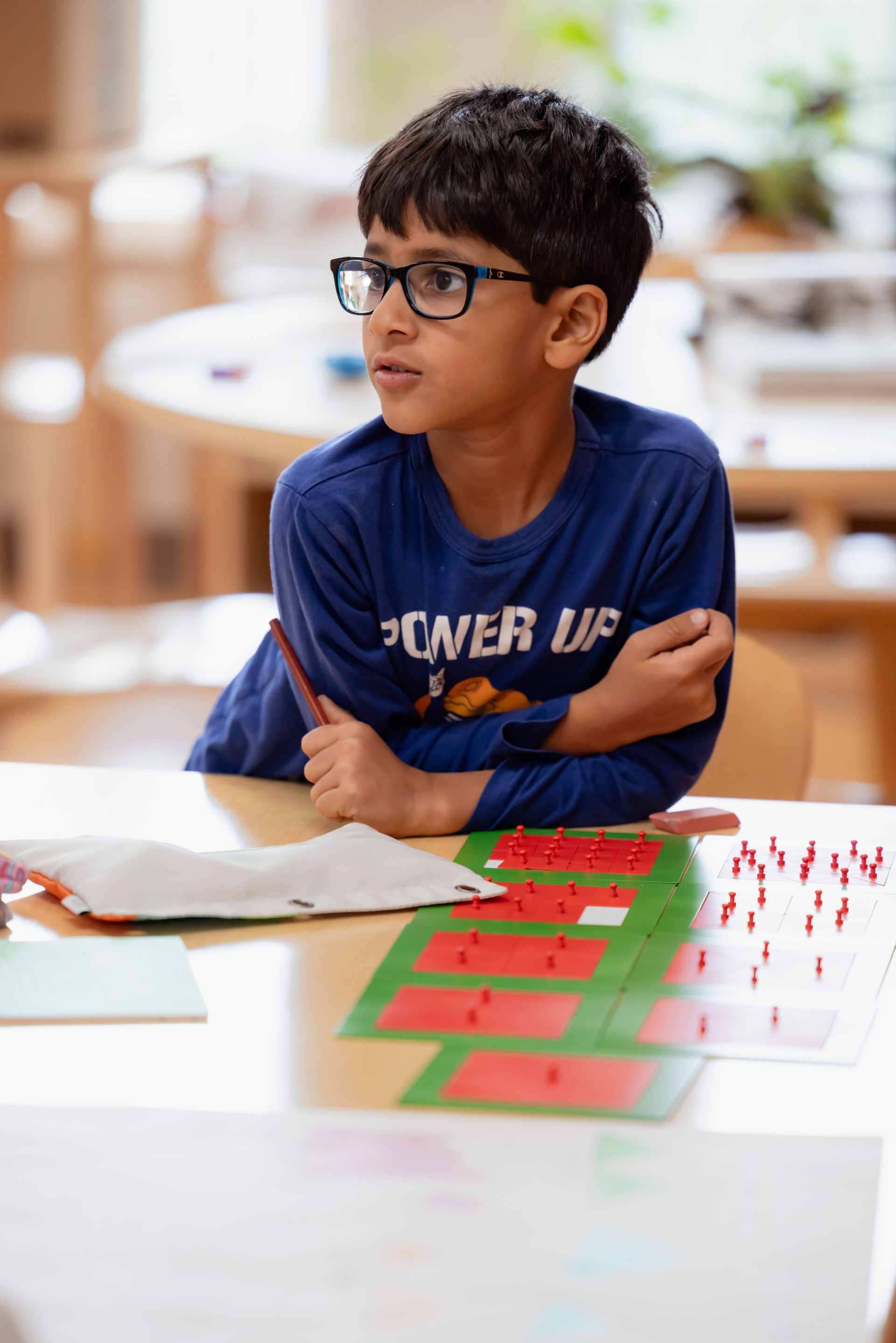
- Purposeful Choice: Children choose their own activities from open shelves containing self-correcting materials.
- Freedom of Movement: Children can work at a table or on a floor mat, walk around to stretch their legs, or use the restroom independently when their body needs to—without asking for adult permission.
- Real Learning in Action: What might look like a simple game or colorful set of beads is actually a carefully designed tool. Beads teach base-ten mathematics and square roots; sorting fabrics refines tactile discrimination; cylinder blocks build spatial reasoning and the fine-motor grip needed for writing.
3. A Rich Curriculum for Young Minds
Because learning is hands-on and self-paced, parents are often amazed by the depth of learning happening in our Children’s House environments. During the morning work cycle, children engage with:
- Practical Life: Pouring, scrubbing, folding, and food preparation (building focus and fine motor control).
- Sensorial Exploration: Refining visual, auditory, and tactile discrimination (the foundation for geometry and science).
- Language Arts: Phonetic awareness, letter formation, and early reading.
- Mathematics: Concrete understanding of numbers, quantities, and operations using physical materials.
- Geography & Cultural Studies: Maps, landforms, and world cultures.
4. Nurturing the Whole Child: Social Growth and Community
In a Montessori environment, social development is integrated into every moment of the day.
In our mixed-age Children’s House classrooms, three-, four-, and five-year-olds learn together. Older children step into leadership roles, offering help to younger classmates and reinforcing their own knowledge in the process. Younger children observe their older peers and naturally aspire to master new tasks.
When social conflicts arise—as they naturally do in early childhood—our Guides don't simply issue time-outs or impose quick fixes. We teach real mediation, active listening, and conflict resolution skills. Through role-playing, stories, and gentle guidance, children learn how to express their feelings, respect personal boundaries, and work through challenges with grace.
5. The Role of the Guide: Observing, Supporting, Elevating
Visitors often notice that our teachers (whom we call Guides) are rarely standing at the front of the room lecturing. Instead, you will see a Guide sitting on the floor giving an individual lesson to a three-year-old, or quietly observing from across the room with an observation notebook in hand.
The Guide’s job is to:
- Prepare the Environment: Carefully arrange materials to match the developmental needs of the children.
- Offer Individualized Lessons: Introduce new concepts one-on-one when a child shows biological and intellectual readiness.
- Observe and Step Back: Allow children to solve their own problems whenever possible, stepping in only when guidance is truly needed.
By trusting children to lead their learning, our Guides help them build resilience, self-reliance, and genuine confidence.
Come See the Magic for Yourself
We invite prospective parents to schedule an observation tour at Stepping Stones Montessori School. You can sit quietly in our classroom, watch our students work independently, and see firsthand how our environment supports your child's natural curiosity and growth.